
Leashes are for safety (and prong collars aren’t for anyone)
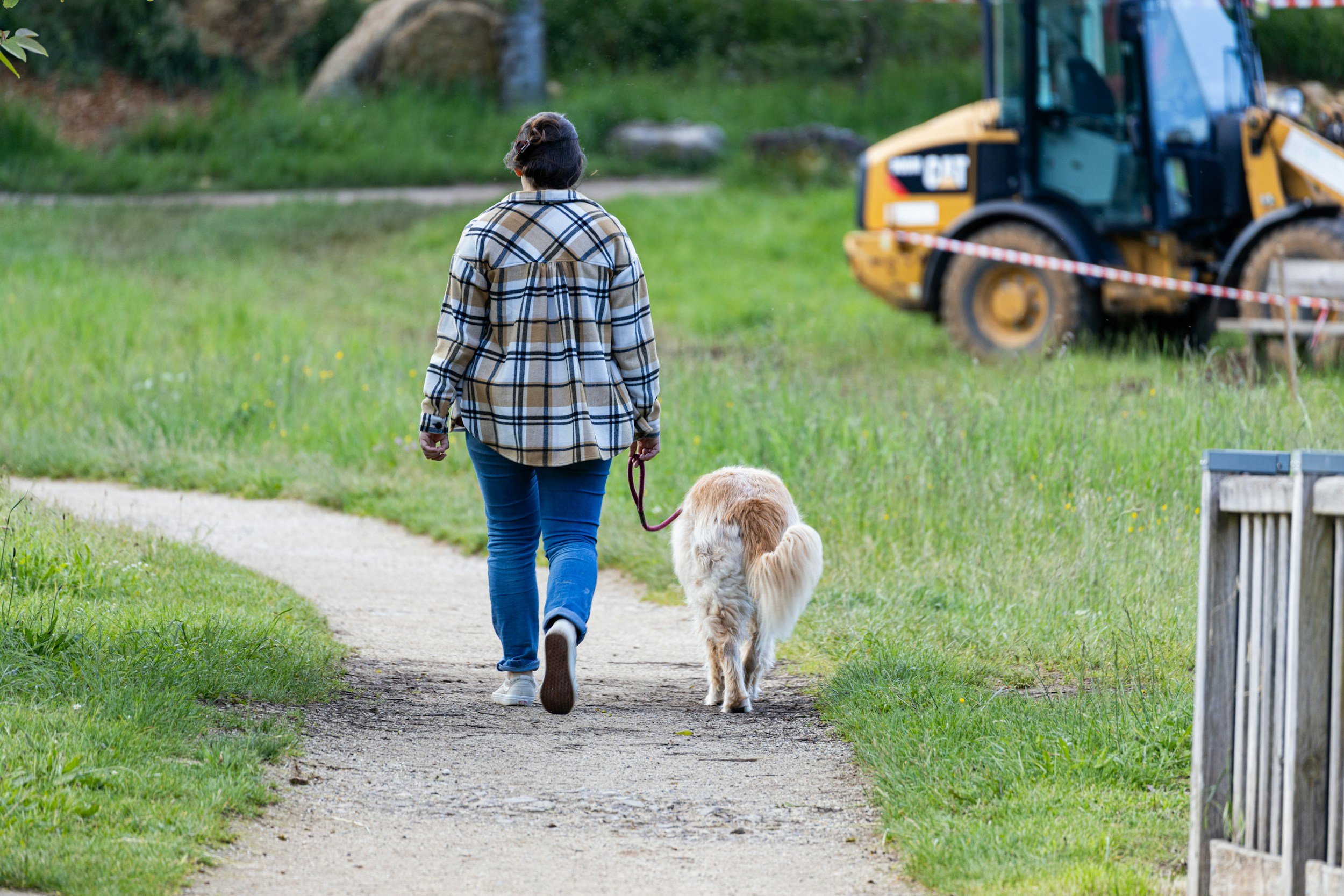
Dog on a walk
You don’t NEED a leash
I’m about to blow your mind. The purpose of your leash is NOT to keep your dog with you while you walk. There. I said it. Take a minute. Think I’m crazy? Think I’m wrong? Humor me and keep reading. You’ve come this far (well, only one paragraph, but still…)
You should be able to walk down the street with your dog near you even if I took the leash away. Sound impossible? “BUT HOW?,” you may ask…
Well, let me start by saying something my wise mentors told me: “Leashes are for safety, not control.” What does that mean? It means the leash is there to be a safeguard against unforeseen events, not as a way to force your dog to walk within 6 feet of you.
But HOW, then?
What, then, is to keep your dog close to you? Good question! The answer is: it’s the best place to be. WHY is it the best place to be? Because by your side is where all the good stuff is happening. I’ll explain that more in a minute.
First, I need to set the ground rules. When you’re on a walk with your dog, you are on the walk WITH your dog. That means you are not wearing headphones listening to audiobooks, you are not talking on the phone to your friends, you are not watching YouTube videos or podcasts. You are ENGAGING with your dog. Walks are your time to be together.
Pee mail
In addition to being your time together, they’re also your dog’s time to check their “pee mail,” which involves a lot of sniffing all the amazing (and likely disgusting to us humans) smells.
Sniffing is extremely important for dogs for many reasons. For example: by smelling another dog’s urine they’re able to tell the age and sex of the dog, their health, what they ate for breakfast, breeding status, etc. They can smell all the wild animals that have walked across the path. They can smell the humans who’ve been there. You get the idea.
All that sniffing is also mentally exhausting. Remember how tired you were after sitting in a room taking an exam? No physical exercise was involved, but you felt like you needed a nap afterward. Same with dogs. You can’t possibly walk or run far enough to tire your dog out as much as a 20-minute sniffy walk! In fact, all that walking and/or running can have the opposite effect of making your dog MORE aroused.
Next to me is the place to be
Okay, back to the leash thing. In our lessons, we focus on making the space near you a “reinforcement zone,” using high value reinforcers, so your dog will CHOOSE to be there/return there after a good sniff. Think: “next to me is the place to be!” and make it so. We will also use pattern games to engage dogs who have big feelings about things in the environment, because distraction doesn’t work.
Hippocrates isn’t just for doctors (aka first, do no harm)
Since we’re on the subject of walks, I feel I need to at least say a word about aversive methods like choke collars, prong collars, and shock collars. These function by causing the dog pain if they pull on the leash, which in theory causes them to stop pulling. In addition to the possibility of irreversible tracheal (windpipe) injury, injury to lymph nodes and thyroid, according to the American Veterinary Society of Animal Behavior (AVSAB): “Based on current scientific evidence, AVSAB recommends that only reward-based training methods are used for all dog training, including the treatment of behavior problems. Aversive training methods have a damaging effect on both animal welfare and the human-animal bond. There is no evidence that aversive methods are more effective than reward-based methods in any context. AVSAB therefore advises that aversive methods should not be used in animal training or for the treatment of behavior disorders.”
Together, wherever we go!
So let me show you how to make next to you the place to be, and let’s walk together with your dog. The leash is just along for the ride…